
People
Malaga doctor brings magic and songs to ICU patients
Intensive care specialist Juan Antonio Fernández tries to ease patients' distress and make their stay more bearable with his little tricks and performances
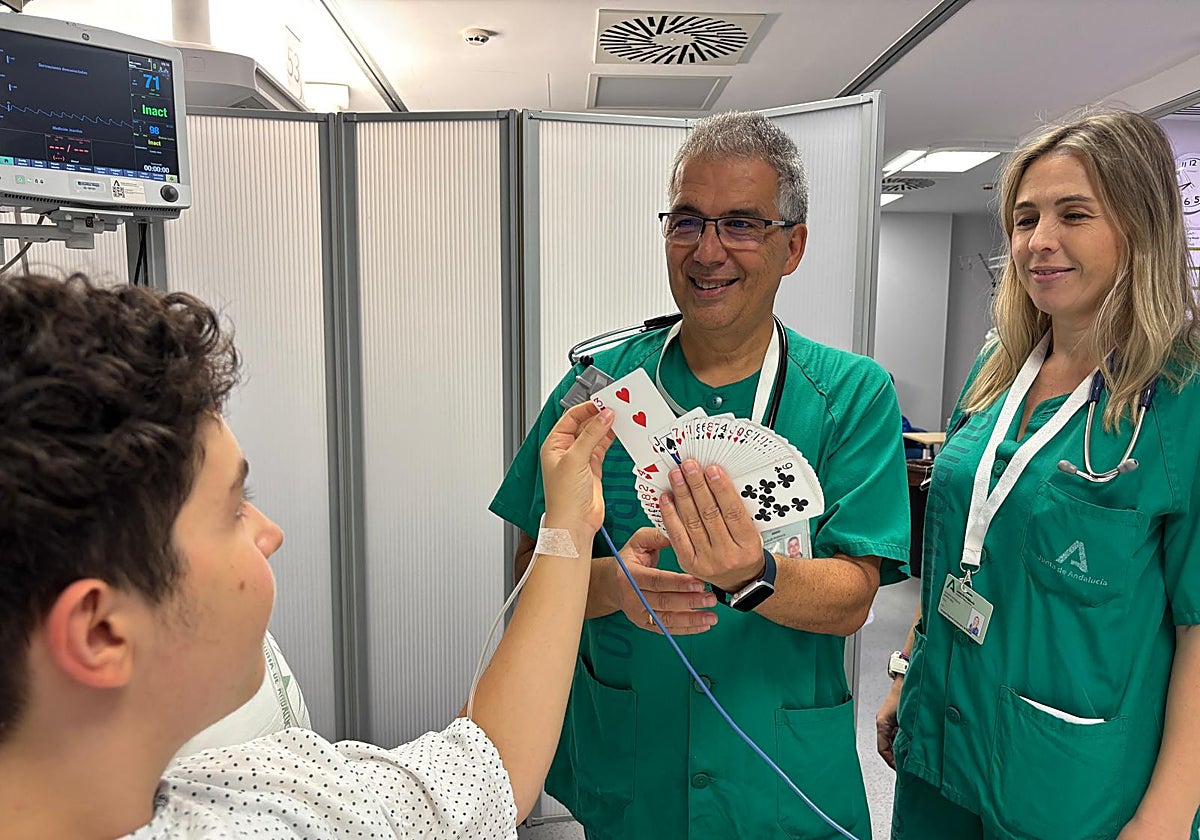

Juan Antonio Fernández Lozano has two names: one is his birth name and the other is Maguci. He is a 58-year-old Almeria-native ... who spent his childhood in the Canary Islands and his professional life in Malaga, working as an ICU specialist in the coronary unit of the city's Hospital Regional.
As well as treating patients with his expertise and skill, Fernández is a magician and singer who uses the arts to help patients during their stay.
He is not a professional magician. He never charges for his magic tricks, but he is a kind-hearted doctor who will go wherever he needs to in order to bring a smile to his patients' faces. The hospital's managing director, oncologist José Antonio Ortega, fully welcomes Maguci's efforts as part of the plan to make the ICU more patient-centred.
"As part of the humanisation of the ICU, music, magic and the arts have healing powers. It's not just what I can do, but what so many other people do. This helps patients spend that time thinking about something other than their illness," Maguci says.
Dr Fernández Lozano studied medicine in Malaga. In fact, he considers himself a native of Malaga. He graduated in 1994. He completed his residency at Hospital Virgen de la Arrixaca in Murcia, before going on to work in Valencia and then returning to the Murcia region, where he passed the competitive examination.
He arrived at the former Carlos Haya hospital in Malaga in 2018, 24 years after his studies.
The trick
His love of magic dates back to 2006. At the time, he was working in Elche and was under a lot of stress. "I went to a medieval market, where there was a man dressed up as Merlin who performed a trick for me. I was absolutely blown away. 'This can't be real,' I said to myself. 'There must be magnets in there.' Not at all. I bought the set and, from then on, I got into it, studying, watching the usual Tamariz videos, and I've been doing magic ever since. I perform it every New Year's Eve, but never professionally, just for friends. I don't earn any money from it," Maguci says.
"Patients in the ICU often spend their time in distress. They are confined to a bed and can only see what is happening right in front of them. They may be unlucky enough to find that the person next to them has died or that another patient's condition has taken a turn for the worse. We do everything we can to ease this stress," the doctor/magician says.
"We gradually help them reintegrate into society in a more positive, pleasant way, rather than simply telling them: 'You've been discharged and you're leaving," Dr Fernández Lozano says.
He performs card tricks, coin magic, mentalism, close-up magic, parlour magic and stage magic and is a member of Círculo de Ilusionistas de Málaga. He performs, for example, free of charge for Afa (association of relatives of Alzheimer's patients) and for hospital patients.
He has experienced some truly heart-warming moments. "There was a young lad who'd undergone heart surgery and was feeling absolutely miserable. I went to see him every day and performed half an hour of magic for him. Obviously, not on the day of the surgery, nor the day after, because he wasn't well enough. I remember staying until 3.30am performing magic for him, because it really transformed his whole demeanour. That really fulfils me. For anyone I see who has the potential, I try to perform magic for them," Dr Fernández Lozano says.
The young man and his parents were delighted to see him arrive. "I love it. I'd almost pay to do it myself," he says.
An 80-year-old patient who'd had heart surgery recognised him and told him he was a fan. He performed in front of the whole family. "The next day, just before I was due to be discharged to the ward, he asked me to wait, called his son over and asked him to give him something. He took out a pack of playing cards and said: 'Could you sign this for me?' I told him I wasn't anyone special to be signing anything, but he insisted and, to be honest, that really moved me."
"I'm the magician of the ICU," Dr Fernández Lozano proudly describes himself. "When I've been offered paid work, I don't usually accept it. I have a bit of a problem: how can I be performing magic at a first communion when, that very same morning, I've had to tell someone that their father is going to die? There's a conflict there that I haven't yet been able to resolve."
He doesn't just perform magic. He also sings. "I've always sung, because they say that singing chases away your troubles. I've spent a lot of time in the operating theatre inserting venous access ports, devices placed under the skin for chemotherapy, or fitting pacemakers and patients would ask me why I didn't put them to sleep and I would tell them it was because I bored them, so I would start singing to them," he says.
For elderly patients, for example, he sings songs from their era so that he himself could relax and the patients wouldn't be thinking about the surgery. "It's a bit like magic: I get you to think about or focus on one thing while I'm doing something else. That way, to be honest, they cope much better," Maguci says.
Patients' consent
He always asks patients and only proceeds with their consent. "Some tell me they'd love it and then I turn up. I don't dress up as a magician. I'm a doctor and I make the most of my breaks or when I've finished my shift."
Everything is for the patient's benefit. "We are in the process of making the ICU more patient-centred. We have a colleague who specialises in this area and, as part of this, we're introducing music, culture and other activities."
Cultura en Vena and one of its volunteers, Diego, regularly accompanies Dr Fernández Lozano on the guitar. "I love all kinds of music. I was in a choir in San Felipe Neri many years ago, when I was young and living in Malaga. Music has always been a part of my life and if someone sings, I'll sing along with them without any problem," Maguci states.
