
Art in Malaga
Archipelago: a collector's 'islands'
Private collection. From Warhol's Mao to an unpublished Picasso - the remarkable world of patron Josep Suñol Soler arrives at Malaga's Thyssen museum
Paco Griñán
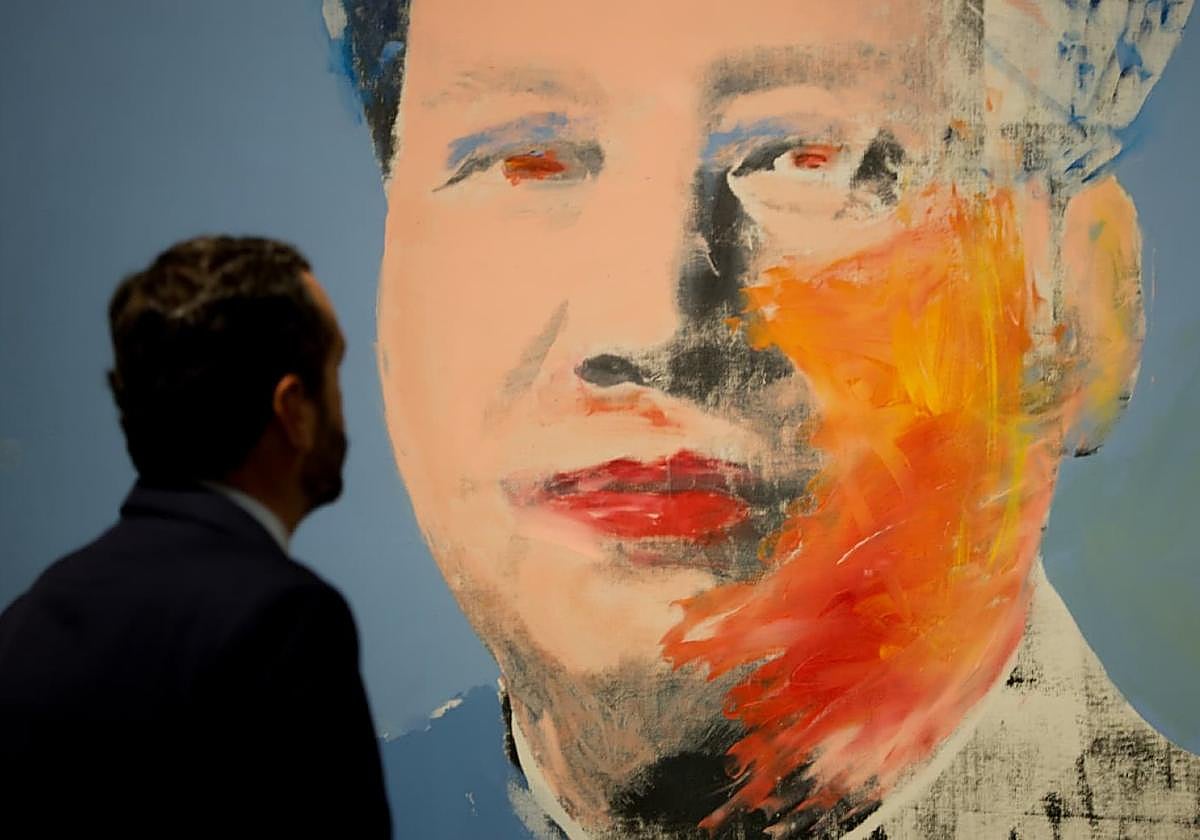
Every day he had his coffee and toast under an imposing Warhol of extraordinary and iconic dimensions. A portrait of 'Mao' (1972) in the style of the pop master that became one of his favourite works and the most famous piece in his collection.
The communist leader in colourful costume catches the eye as you enter the Museo Carmen Thyssen's new exhibition, Archipiélago, which brings to the third floor of the Palacio de Villalón the collection of Josep Suñol Soler (1927-2019), one of our country's most personal and exceptional patrons.
He turned his Pedralbes house in Barcelona into a museum of contemporary art with works by Picasso, Braque, Miró, Tapies, Canogar, Chillida, Gordillo, Guinovart, Lootz, Miralles and Scully. Artistic jewels for your eyes only which, from this Saturday, can be enjoyed until 6 September in Malaga.
-U61346571850nDp-944x660@Diario%20Sur.jpg)
If the works speak of their artists, the collections portray their owners. And Suñol Soler's collection portrays a businessman who, since the 1970s, not only invested money, but also had the sensitivity to put together a catalogue of contemporary art ranging from the avant-garde of the early 20th century to the emerging artists of the late 20th century, whom he also liked to visit personally.
Archipélago' not only exhibits symbolic works, but also unpublished pieces
Rodrigo Navia-Osorio Vijande, president of the Fundación Suñol, explained that "he exchanged the boards of directors for the studios of the painters and sculptors", about the patron who created this collection, which he himself knows first-hand as the benefactor was his godfather. "I have slept in the rooms that exhibit these paintings and I have eaten with 'Warhol'," he confessed about this two-metre-high piece that is "absolutely iconic and fundamental" to the collection and to the pop culture of the last century.
During the presentation of the exhibition, Nava-Osorio pointed out that Suñol Soler's arrival in patronage was not vocational, but rather casual, when he moved into his new house and asked the father of the now president of the Foundation, the gallery owner Fernando Vijande, for help in "decorating" the residence.
"But as the house was so big, he got the bug, wanted to get to know the artists and collecting became his passion," recalled the expert, who pointed out that, as can be seen in the Museo Carmen Thyssen, we are dealing with a "very eclectic" collection. "That is why I think the title Archipelago is a good choice for the exhibition, because the collection is made up of different artists and styles that are islands," he said of the selection of around fifty works - mostly paintings, although there are also sculptures - out of the thousand pieces that make up the patron's complete catalogue.
From Miró to Carmen Calvo
The exhibition, which coincides with the Museo Carmen Thyssen's fifteenth anniversary and is supported by Fundación 'La Caixa', is divided into five 'islets' that form this archipelago that goes far beyond Warhol's emblematic Mao.
"We also have important works by Miró and Braque, while in the final part of the material painting section we have the gigantic work of Canogar, and in the Spanish abstraction section, before the crisis of informalism, we have Carmen Calvo and Tapies, who is well represented in the collection," commented Bárbara García, curator together with Alberto Gil of this temporary exhibition, which has brought into "dialogue" works that had never before been exhibited together.
Symbolic and representative
In fact, the expert stated that we are dealing with one of the great Spanish private collectors, together with Pilar Citoler and Carmen Thyssen herself, whose museum in Malaga is hosting the exhibition, and stressed that this collection has yet to be discovered, as it began to be exhibited publicly at the beginning of the 21st century.
Thus, Archipiélago not only exhibits symbolic and representative works, but also unpublished pieces that are being shown for the first time by Eduardo Chillida, Ràfols-Casamada, Antoni Llena, Giorgio Griffa and Darío Villalba.
Alongside the three pieces by the latter Basque artist, another of the exhibition's landmarks, Bust of a Woman in a Yellow Blouse' (1943), a recognisable portrait of a woman by Pablo Ruiz Picasso, painted in collage on wood and which also has a story behind it, is also on display.
"It is a very particular work that a few years ago we were asked by the Picasso Museum in Barcelona for an exhibition and they found a photo of Paul Eluard in his house with this painting behind it," explains Rodrigo Navia-Osorio Vijande about this piece that was a gift from the Malaga artist himself to his friend and French poet in the 1940's. And in a final twist, this Picasso entered the art market and ended up in the coveted Suñol Soler collection.
This work is another of those "living pieces" that give the exhibition a special character, as the president of the Foundation stressed, who also emphasised that the selection made by the curators of the Museo Carmen Thyssen is "different" to that of the institution he directs and allows us to "discover in a different way this collection that ranges from figuration to abstraction, passing through the material and pop".
Navia-Osorio Vijande also emphasised the three major works on display by the Andalusian Luis Gordillo, whose patronage by Josep Suñol in the 1970s enabled him "to stop giving French classes and devote himself to painting, becoming this great painter," he commented, pointing to his large two-metre canvases.
Most of the works on display were acquired in the 1970s, when collecting in general focused mainly on male artists. "But here we have the sculptor Susana Solano, Fina Miralles, Carmen Calvo and Eva Lootz, four women, which at that time was something very rare," commented Josep Suñol's godson.
A varied representation of contemporary art that was also valued by the artistic director of the Museo Carmen Thyssen, Lourdes Moreno, who applauded the staging of Archipiélago as it offers "a very accurate look at what happened in those years in contemporary art in our country, as well as featuring great international names".
-U00562128167srY-944x660@Diario%20Sur.jpg)
The head of programming at the art gallery highlighted the happy coincidence of the opening of this exhibition "of one of the most important collections in our country" with the 15th anniversary of the Carmen Thyssen Centre itself.
Crossed the line
"We have crossed the line of maturity and we have a solid and cohesive team," declared Lourdes Moreno, who congratulated the different departments of the museum and expressed her "gratitude to the team of the museum's manager Javier Ferrer.
Moreno encourages visitors to visit the museum because, in addition to the contemporary art of Archipiélago, there is the recent opening of a new 'room' in the basement of the building in which an archaeological site is exhibited, allowing visitors to see a Roman villa from the 1st to 5th centuries AD.
It includes a fountain with the oldest mural painting in Malaga.
![[]](http://static.vocstatic.com/voc26/latest/assets/images/favicon/surinenglish/apple-touch-icon-57x57.png)