
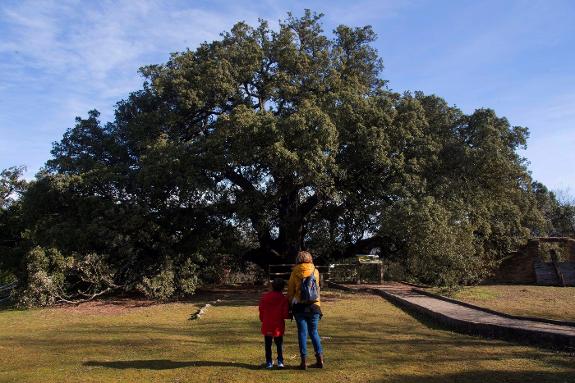
The award-winning tree that got rid of the witches
La Castañera, a thousand-year-old holm oak in the hamlet of Lecina, in Huesca, has been voted European Tree of the Year
ALFONSO TORICES
Sisters María Jesús and Felisa Arasanz were euphoric this week, and so were their ten or so neighbours in the tiny hamlet of Lecina, in Huesca, when they learned that their thousand-year-old oak tree, known to everybody as La Castañera, had been voted European Tree of the Year.
La Castañera is an enormous holm oak, 16.26 metres high and with branches extending to a total width of 28 metres. It stands alone in this diminutive community in the Alto Aragón, in the municipality of Aínsa, near the Somontano vineyards and the Ordesa y Monte Perdido national park.
This beautiful tree, under which dozens of couples have been married, has been the setting where hundreds of discussions have taken place and agreements made. It was saved by Nicolás, María Jesús and Felisa's father, who adored it. These sisters, who recently retired, remember when they were young and he absolutely refused to sell it to a charcoal merchant who was prepared to pay a lot of money for its seven-metre trunk and large twisted branches.
The holm oak, guardian of the woodlands and also a symbol of resistence, life and strength, was a sacred tree for the ancient Greeks, and also for the people of Aragón, who claim it played an important role in reconquering the valleys of the Pyrenees from the Saracens. That is why it ended up being featured on the kingdom's coat of arms, and is now the emblem of Aragón.
However, La Castañera, which was given that nickname because every winter it used to produce up to 600 kilos of fat, sweet acorns which the sheep loved to eat, has a magical legend of all of its own. For generations local people have venerated it because hundreds of years ago, when it was still a young tree, it is said to have helped to rid the area of the witches who brought bad luck and death to residents and their animals.
The legend
In those times, Lecina was surrounded by impenetrable woodland, in which witches are said to have hidden. The trees in the woods loved these sorceresses because local people were too afraid of them to come in and cut them down. But La Castañera didn't approve of this woodland's bad reputation, and persuaded many young trees to join forces and oppose the witches, who eventually decided to leave.
But before they went, they granted wishes to the trees. Some said they would like to have branches of gold or crystal, and others wanted a delicious fragrance. The young La Castañera didn't want anything.
Over time, shepherds cut down the trees whose smell was so attractive to cattle, the crystal branches were smashed by storms and thieves stole the trunks of gold. All that was left of the ancient woodland was this large holm oak, that earned the respect and reverence of everybody.
And now, to the immense pride of the villagers, their tree has beaten 13 other emblematic examples to become European Tree of the Year. It received 104,264 votes, which was 25,000 more than the tree that came second, an Italian plane tree, and nearly twice as many as the ancient Russian sycamore in third place.
![[]](http://static.vocstatic.com/voc26/latest/assets/images/favicon/surinenglish/apple-touch-icon-57x57.png)