
International
More than 1,300 people are missing – four of them Spanish – and 270 have died in the devastating flash flood between Nepal and Tibet
Scientists from all over the world are investigating what happened in the hope of finding more precise answers, although the initial theory suggests that an earthquake was followed by a landslide

Corresponsal. Pekín
As the rescue efforts continue, the true scale of the natural disaster that devastated the border region between Nepal and China yesterday is beginning to ... emerge.
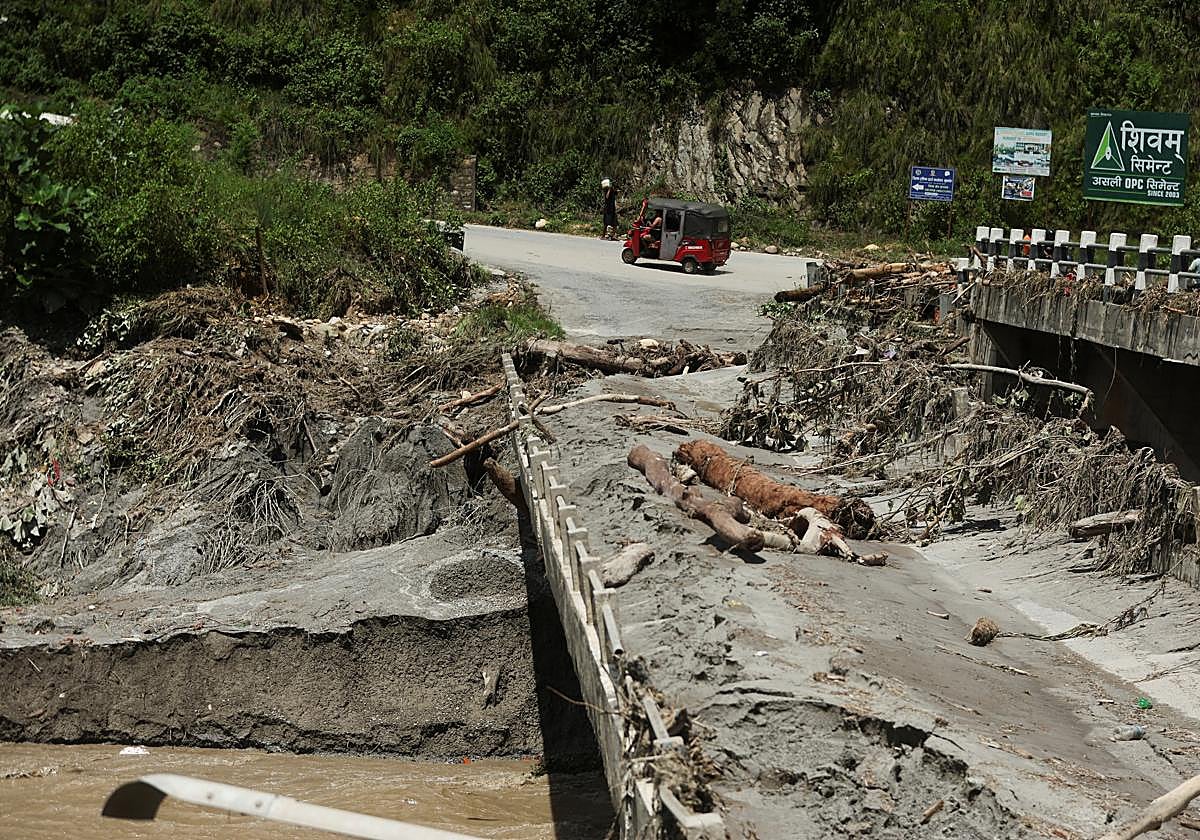
A series of landslides and flash floods has swept away entire villages, leaving – according to figures that are still provisional – at least 177 dead and more than 1,300 missing.
The vast majority of the fatalities are concentrated on the Nepalese side. In turn, 64 of them are in the Chitwan district. This area is a very popular tourist destination due to its Hindu pilgrimage routes along the Narayani River. For this reason, many of those whose whereabouts are unknown are travellers.
Nepal puts the number of missing people at 826, 466 of whom are foreign nationals. China, for its part, has reported via its official media that 558 people are missing, 260 of whom are foreigners, and that three people have died. It is unclear to what extent the two countries’ operations are co-ordinated, so there may be cases of victims being counted twice.
Among those missing, according to Spain’s minister for foreign affairs, José Manuel Albares, there are at least four Spaniards who have not been located.
Albares also emphasised that there are no reports of any Spanish nationals having died, but he has asked the families and friends of Spanish nationals who are known to be in the disaster-stricken area, or who have been there, to contact the ministry of foreign affairs’ emergency hotlines, either the consular emergency unit or the central services in Madrid.
Natural explanation
What is beginning to become clear is the causal link between natural disasters. Initially, the Nepalese Government, through its Foreign Minister, Shishir Khanal, stated that a 4.4-magnitude earthquake had triggered a landslide which blocked the Bhote Koshi River – part of the Narayani river basin – which in turn caused a violent flood.
However, the US Geological Survey has confirmed that what was initially recorded as an earthquake “was in fact a glacial collapse and a debris flow” which “caused subsequent catastrophic impacts downstream”. The Nepalese authorities have accepted this hypothesis as the most likely explanation – namely, the break-up of a colossal mass of ice from a glacial lake, as had previously occurred in July 2025, an incident that left 11 people dead.
This is not incompatible with the possibility that, as suggested by initial reports, the avalanche blocked the course of the Bhote Koshi River – whose waters flow into the Trishuli River before reaching the Narayani – causing a huge build-up of water that was suddenly released. The area had not experienced any exceptional rainfall in the hours leading up to the event, so local residents had no warning whatsoever of the arrival of the immense, destructive wave.
Scientists from around the world are continuing to investigate what happened in the search for more precise answers. The international centre for integrated mountain development has warned that narrow stretches of the Trishuli may remain blocked by sediment, which could trigger a second flash flood.
The US Geological Survey has confirmed that what was initially recorded as an earthquake “was in fact a glacial collapse and a debris flow” which “caused subsequent catastrophic impacts further downstream”
Nepal has deployed 2,000 military personnel to carry out search operations on the ground and from the air. The troops are concentrating their efforts on the worst-affected areas, the districts of Rasuwa and Nuwakot, where they have managed to rescue 97 people.
Efforts on the other side of the Gyirong Pass – the mainland crossing between the two countries – have been hampered by weather conditions and the destruction of the infrastructure that enables operations in these remote areas. On the Chinese side, the landslide is one and a half metres deep and stretches 2.5 kilometres from the border.
![[]](http://static.vocstatic.com/voc26/latest/assets/images/favicon/surinenglish/apple-touch-icon-57x57.png)