
Granada earthquakes
Andalusian regional government calls for civil protection emergency to be declared for 16 municipalities affected by the earthquakes
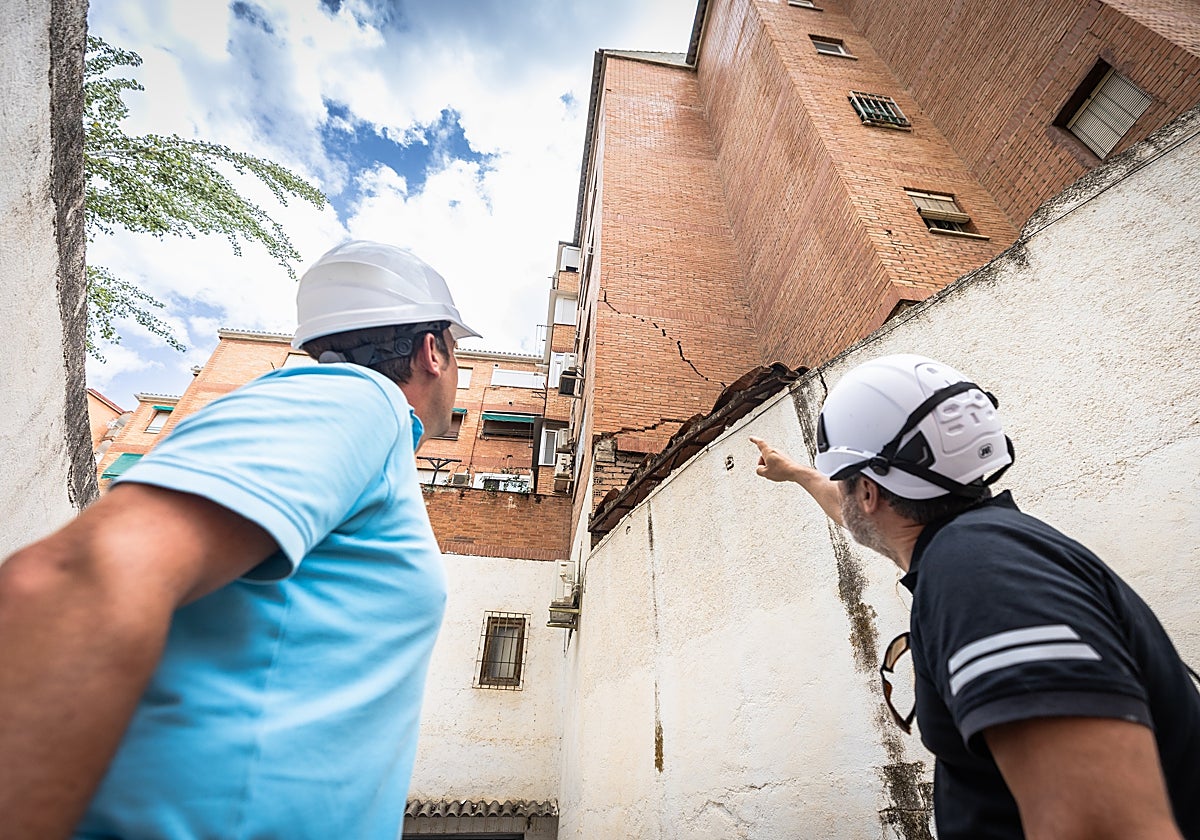
The series of tremors in Granada throughout Augusut resulted in more than 4,000 emergency call-outs, with La Vega and El Zaidín being the worst-hit areas

Pilar García-Trevijano
Granada
The Andalusian regional government has requested that the municipalities most affected by earthquakes and fires in the region this summer be declared civil protection emergency ... areas.
In Granada province some 16 municipalities have been affected by the series of earthquakes, which were felt in 48 municipalities across eight different areas, although the most significant damage is concentrated in the areas around La Vega and El Zaidín.
The sequence of more than a1,000 earthquakes that occurred throughout August resulted in 14 people requiring medical attention, although fortunately there have been no fatalities or serious injuries. According to the regional government 4,169 emergency calls were handled in response to the seismic series and the emergency plan remains in effect at Operational Level 1.
According to Carolina España, spokesperson for the Andalusian government, the request sets out the legal measures required to mitigate the damage caused by these events and concerns municipalities that were not included in the ministers’ agreement of 28 July. In total, there are 31 localities: 15 villages affected by wildfires in Almeria, Granada, Huelva and Seville provinces and the other 16 municipalities in Granada damaged by the earthquakes. “They have caused damage to property and personal injury. We believe that the scale of these events justifies the request to the central government to address the consequences,” España stated at a press conference.
Affected municipalities
The 16 municipalities in Granada and included in the application as a result of the recorded seismic series are Alhendín, Armilla, Cájar, Churriana de la Vega, Cogollos de la Vega, Cúllar Vega, Gójar, Granada, Huétor Vega, La Zubia, Las Gabias, Maracena, Ogíjares, Santa Fe, Vegas del Genil and Villa de Otura. The central government has already stated that it would approve the declaration of a ‘Catastrophe Zone’, formally known as an area affected by a civil protection emergency, for Granada and announced an investment of over one hundred million euros during a visit by Minister Carlos Cuerpo. With this procedure, the Andalusian government is taking a further step towards formalising the request.
Furthermore, the 15 towns most affected by wildfires are Las Tres Villas and Nacimiento in Almería; in Granada, Lecrín; in Huelva: Berrocal, El Campillo, Escacena del Campo, La Palma del Condado, Lepe, Niebla, Paterna del Campo, Valverde del Camino, Villalba del Alcor, Villarrasa and Zalamea la Real; and in Seville: Aznalcóllar.
The wildfires and seismic events recorded over recent weeks have caused both material damage to privately owned property, infrastructure, facilities, installations and public services, as well as personal injury.
The Andalusian regional government considers that the scale of these incidents justifies requesting that the Spanish government issue the relevant declaration and take the necessary measures to deal with their consequences.
The measure will "undoubtedly enable the Council of Ministers to approve financial aid for individuals and other forms of compensation’. Furthermore, the Andalusian government is to take measures under Decree 277/2023, which permanently regulates emergency aid for local authorities affected by adverse natural phenomena, public disasters or civil protection emergencies. Under this regulation, the Andalusian regional government is activating extraordinary funding schemes to provide aid to local authorities for measures aimed at repairing and mitigating the losses suffered, with a view to restoring normality to the affected areas.
Coordinated response
In an interview on Canal Sur Radio, the minister maintained that the public is unaware of the key measures needed to ensure their own safety. “Frankly, we don’t know how to protect ourselves and we do the opposite of what we should be doing. One of the objectives of this term of office is to pass a decree on self-protection and to foster a culture of prevention and awareness regarding emergencies. We must also be more responsible. Earthquake sequences cannot be predicted, and we must be prepared so that we know how to act,” he stated. “People tend to go out onto the streets; in Lorca, apart from the person who suffered a heart attack, the remaining 12 fatalities were caused by falling sections of façades and cornices,” he recalled.
Sanz has reiterated that the situation “requires a coordinated response” to deal with the unforeseen events of a seismic series comprising more than a thousand earthquakes, only 15 of which were above magnitude three, and four earthquakes measuring over four. Finally, he urged members of the public that, if they are indoors when an earthquake happens, they should remain there, unless the building is unsafe. “Most of the emergencies we have attended have involved people who have rushed out,” he added.
Although there is no procedure with set requirements, the usual steps for obtaining this declaration are for the local authority or the regional government to submit a request, accompanied by reports justifying the application, such as evidence that an emergency has occurred, an assessment of the causal link between the incident and the damage, and documentary evidence of the damage.
The government sub-delegation or the regional government submits this request, together with the supporting documentation, to the directorate-general for civil protection either directly or via the government delegation, in accordance with the instructions. The directorate-general examines the specific case and, if it deems it appropriate, forwards it in turn to the Council of Ministers, which must approve it.
![[]](http://static.vocstatic.com/voc26/latest/assets/images/favicon/surinenglish/apple-touch-icon-57x57.png)