
Interview
Andalusian tourism minister: 'The deterioration of our international image and rail safety concerns are a threat to tourism'
The vice-president of the regional government and regional minister for tourism, Manuel Gavira, states: “I don’t want more tourists to come. I want them to generate more revenue and more jobs”

Málaga
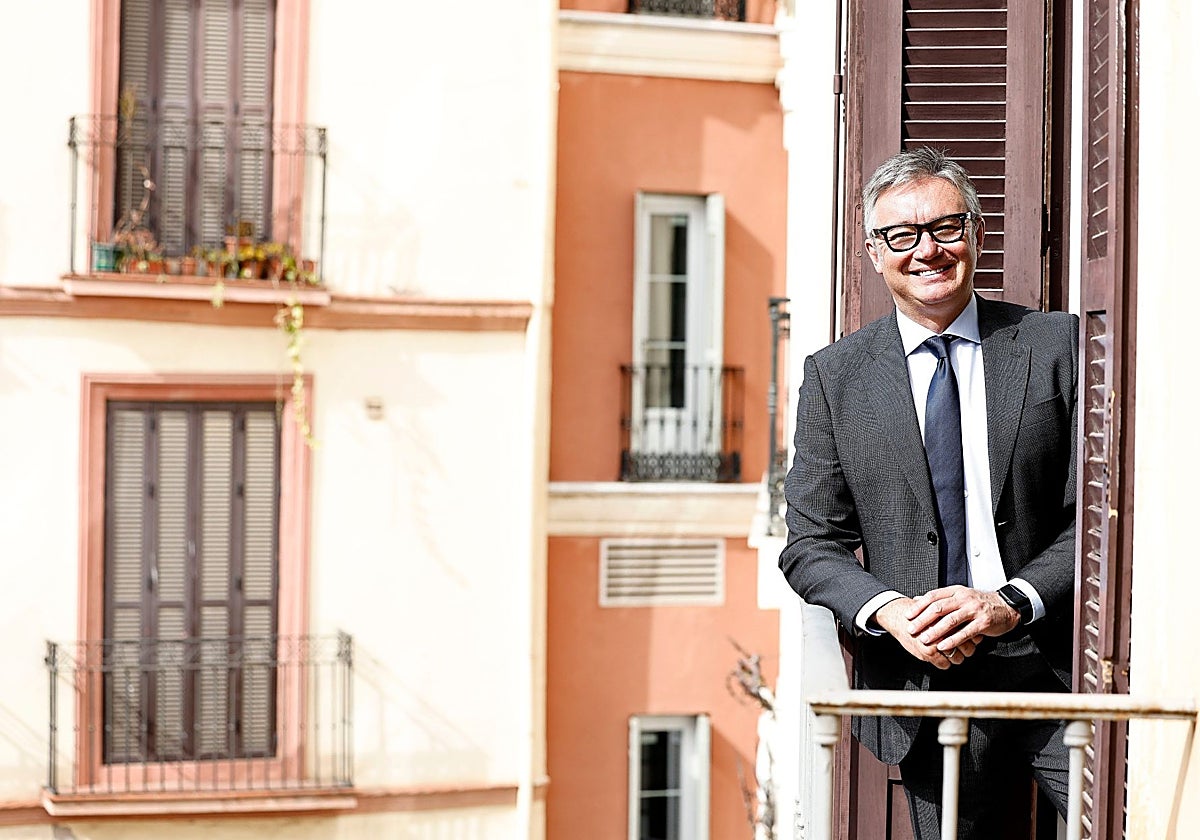
From a self-made lawyer to the helmsman of Andalusian tourism. The son of a baker and a housewife, Manuel Gavira - second vice-president of ... the regional government of Andalucía and regional minister for tourism, justice, local government and deregulation - was forced to take on the role of head of the family at an early age following the untimely loss of his parents.
The current spokesperson and regional figurehead for Vox makes no secret of his origins: his heart belongs to Cadiz Football Club, to the rhythms of his homeland’s carnival and to the timeless voice of Camarón.
Having had no involvement in politics until a single sheet of paper setting out ten Vox policies changed the course of his life in 2014, Gavira comes across in person as a family man for whom the best destination always begins and ends in his native Cadiz.
He has just appeared before the media to present Andalucía’s participation in the World Travel Market (WTM), which begins this Tuesday in London.
He becomes visibly shaken when speaking of the latest rail disaster in Urda, in which 69 people have died, and sets out his strategy at the helm of tourism with complete conviction: “I don’t want more tourists to come; I want them to generate more income and jobs and to visit more parts of Andalucía.”
– You have been in post for 108 days, and the last few have been particularly eventful following the train accident in Urda...
-Spain is in mourning following a rail tragedy that has claimed dozens of lives, left many injured and shattered families. We share their grief, their outrage and their anger. We demand justice. But the consequences of this tragedy could also cause extremely serious economic damage to Andalucía. The damage to Spain’s international image and doubts about the safety of our rail infrastructure pose a direct threat to tourism, one of the main drivers of our economy. Behind the tourism sector lie thousands of Andalusian businesses, self-employed people, workers and families who may suffer the consequences of a loss of confidence among visitors, transport connectivity issues and a decline in economic activity. Spaniards have the right to travel safely, and the people of Andalucía should not have to pay the price for the incompetence of the Sánchez government.
– In a matter of hours, your first international trade fair, the WTM in London, will open. What are your objectives for tourism?
-I have just presented the proposal we are taking to London, which summarises our strategy: we want to shift the focus from the volume of tourists to value. We want tourism in Andalucía to be of a higher quality and to reach the whole of Andalucía. Both on the coast and inland. And we’re going to work to ensure, above all, that it creates wealth, opportunities and jobs throughout the region, so that all Andalusians can benefit from tourism in our region.
– Will the Tourism Law - which was just one day away from being passed when the regional elections were called - be one of the first measures to be implemented?
-The regional ministry intends to press ahead with the Tourism Law because we understand that it has been agreed upon by a large part of the sector. There are aspects which we believe could be improved, and we will work on these to add something to the act which even industry professionals acknowledge was not previously included. Our aim is for it to be passed in the first half of next year.
– You’re taking the reins of Andalucía’s economic mainstay at a time when this industry is under intense scrutiny. What would you say to those who continue to spread anti-tourism rhetoric?
-To those who perpetuate the narrative against tourism - that old-guard left that doesn’t want wealth, doesn’t want jobs, doesn’t want opportunities - I would say that in Andalucía there are more and more Andalusians who make a living from tourism and who depend on it for their livelihood. It is a very important sector.
“We want to refine certain aspects of the Tourism Act so that it can be passed by the Andalusian Parliament in the first half of next year”
– Do you agree with the three-year moratorium approved by Malaga city council on holiday homes, hotels and apartments?
-Malaga city council has taken a decision, and we must respect the respective powers of each body. The point here is that this decision should have been analysed before it was taken. I can understand that Malaga is a city with a lot of tourism and that it has a housing problem, which is not caused by this sector or even by holiday rentals. I believe the adoption of these measures is a step in that direction. I can understand that there are areas of Malaga where this problem may exist, but not in others. I must respect the decision taken by the city council.
– I was talking precisely about the problem of the housing shortage and this account which points the finger at tourism as the culprit...
-But tourism is not to blame for the housing shortage; it really isn’t. Not even tourist accommodation. Blaming tourism for the housing problem is misguided. You only have to look at the fact that this is a situation occurring throughout Spain - not just in areas with high levels of tourism - to see that the root of the problem is a lack of new-build housing. Why isn’t new housing being built? Because land isn’t being made available for development, there’s no support for construction companies or buyers, and taxes aren’t being reduced. The tourism sector is being unfairly vilified. We cannot remain silent. The problem is that there is no new building taking place.
– In fact, the housing crisis is also affecting the tourism sector, which is struggling to find staff...
-The tourism sector is a victim, as are the health and education sectors. It is a problem that affects us all. But it seems that tourism is being blamed. And it makes no difference that there are fewer and fewer holiday homes, as this keeps the housing shortage and high prices going. Over the last year or year and a half, there have been 18,000 fewer holiday homes in Andalucía. But the problem remains.
“The idea is to attract visitors with greater spending power from markets such as the UK, Asia and North America”
– You have already indicated that you do not agree with setting a tourist tax. With an election campaign just around the corner, are you proposing any changes to make this tax work?
-What we have said is that introducing a tax is a simplistic solution to the problem of funding for tourist towns. And I haven’t heard a single mayor say: "With the revenue from the tourist levy, we are going to tackle precisely the damage that may be caused or the risks posed by mass tourism, such as public services, cleaning, waste collection or security." They all say something else. And what we’re saying is that there is a solution. Why not use the Ley de Haciendas Locales, which contains a clause specifically addressing tourist municipalities? Are we seeking municipal funding through a tourist tax? Are we blaming tourism? Because if we have a problem with municipal public services, let’s tackle it at national level; let’s draw up a regulation that takes into account those cities in Andalucía and Spain which receive the highest volume of tourists and ensure they have better funding. But the easy option is simply to set a tax.
– Speaking of proposals, how are you approaching the 29 November campaign against this backdrop of unrest and tension?
-29 November is the last chance we Spaniards will have for change. Because what we are seeing is a government that did everything it said it would not do in order to come to power. Everything it said it wouldn’t do, it went and did. And now it is doing everything it can to stay in power. The nationalisations and the issue of the ‘Grandchildren’s Law’ are part of an attempt by Sánchez’s government to rig the election. That is why we say this is our last chance, because if we give them more years, they will surely do everything in their power to remain in power indefinitely. We want to see a massive mobilisation; we want the people of Andalucía to turn out in droves to vote for that change – so that we Spaniards come first, for an honest government and, once and for all, the one we deserve.
– Returning to the tourism sector and that strategy of focusing on tourism with higher added value. Are you continuing to work on establishing links with long-haul destinations such as Asia or the United States?
-That is why we say we want to move from volume to value. We want tourists who come here, stay for many days and spend a lot of money. That is why we have taken particular care to convey this message at the World Travel Market in London. The British market is very important. It accounts for 20 per cent of the foreign visitors coming to Andalucía. We must therefore look after it, pamper it, entice it and convince it that it has everything it’s looking for here, but we mustn’t forget the Asian market. We are talking about tourists with this profile. They are travellers who are greatly appreciated by local residents and, of course, by the tourism industry as well. This is the balance we want to achieve between residents, visitors and the region. The same applies to the United States and Canada.
“Tourism is not to blame for the housing shortage. We cannot just sit back and do nothing. The problem is that not enough is being built”
– Another problem facing the sector is the difficulty in recruiting professionals. What measures do you propose to address this situation?
-We must raise the status of these professions, ensuring that the career paths are attractive, appealing to people and offer good working conditions. We need skilled professionals. We must highlight the value of work in the tourism sector. Only by adding value to these professions will we put an end to this problem. If we think that just anyone is suitable for the tourism sector or the hospitality industry, we would be making a mistake, because what is needed are professionals. We need to focus heavily on education and vocational training.
– Another key to competitiveness is innovation. What are you working on to ensure that Andalucía remains at the forefront?
-I have a Secretary-General for Tourism, Manuel Lara, who is very keen on data and information, and who knows that through them and through that analysis we will be able to achieve our objective. In fact, in London we are going to use various artificial intelligence tools so that it is not just those sitting around a table who want to come to the region and work with operators in Andalucía, but so that people can also see what we have to offer. It is through the analysis of data, information and artificial intelligence that we will achieve our goal of ensuring that tourism reaches and benefits the whole of Andalucía.
– And to round off the section on tourism, are you optimistic about the results you’re forecasting for this year?
-Yes, yes, but, honestly, I don’t want more tourists to come; I want those who do come to stay for longer, generate more revenue and create more jobs in more parts of Andalucía. The challenge is to diversify. I don’t want to come back from London saying that I’ve showcased just how beautiful Andalusia is at a big exhibition. What I want is for business to be done and for opportunities to be created so that tourists then come and generate jobs. Anything other than that will be a failure.
“Within the Andalusian Regional Government, the relationship between the Partido Popular and Vox is good, cordial and polite. We have come a long way.”
– Let’s move on to Justice. What challenges has the ministry set itself for the administration of justice?
-I have spoken before about my Secretary-General for Tourism, who is widely recognised throughout the sector. Well, the same goes for María José Cañizares, Secretary-General for Justice and a superb professional. Clearly, the justice system in Andalucía faces many different kinds of problems. In the few days since we took office, we have strengthened the courts, particularly on the Costa del Sol. And we are going to create more posts over the coming months so that we can respond more quickly. We have called for the creation of new judicial bodies – a demand made by the High Court of Justice – and the reinstatement of the OCON [Guardia Civil elite drug squad] to combat drug trafficking. We are talking about staff, judicial bodies, greater security and giving due importance to the justice system.
– Your wide-ranging remit also includes Local Government and Deregulation...
-Deregulation is what people most often congratulate me on in the street, because it affects everyone. You only have to look at the reports from self-employed workers’ associations, which show that they lose 28 days a year to red tape, resulting in an economic impact of 2,000 million euros and the loss of 136 million hours. That is why deregulation is something we must keep firmly in mind, and why we have presented the Quality and Regulatory Simplification Plan, which analyses the region’s administrative regulations in an effort to streamline procedures and turn administrative silence into a positive outcome wherever possible, while ensuring the highest standards of protection. We want to make everything easier.
“On 29 November, we want to see a massive turnout; we want the people of Andalucía to turn out in droves to vote for that change. It’s our last chance”
– How would you sum up these hundred-odd days of coalition government with the PP?
-We want the same for Spain as is happening in Andalucía and other parts of our country. I believe that the Partido Popular and Vox have matured considerably. It is a question of not repeating past mistakes. At national level, we must oust this corrupt and treacherous government we have in order to start building the Spain we truly deserve. Quite simply. But if you ask me about the relationship within the Andalusian governing council, I can tell you that it is good, cordial and respectful. I am learning a great deal. We are two different parties and, obviously, there are things we do not agree on, but we are clear that, in this specific case, this pact represents an improvement for Andalucía. And we want that to be replicated across Spain.
