
Tourism
Almuñécar calls for additional state funding for tourist towns
The mayor of the Costa Tropical town is spearheading a national debate on the allocation of funds to sustain public services and is seeking allies in other Andalusian towns facing similar pressures including Chipiona, Nerja and Torremolinos
Inés Gallastegui
Granada
The mayor of Almuñécar, Juan José Ruiz Joya (PP), wants to launch a nationwide debate on the funding of Spanish tourist destinations with a view ... to amending the current state revenue sharing scheme (PIE) so that, in addition to the registered population, the actual population served by local councils during certain periods of the year is also taken into account.
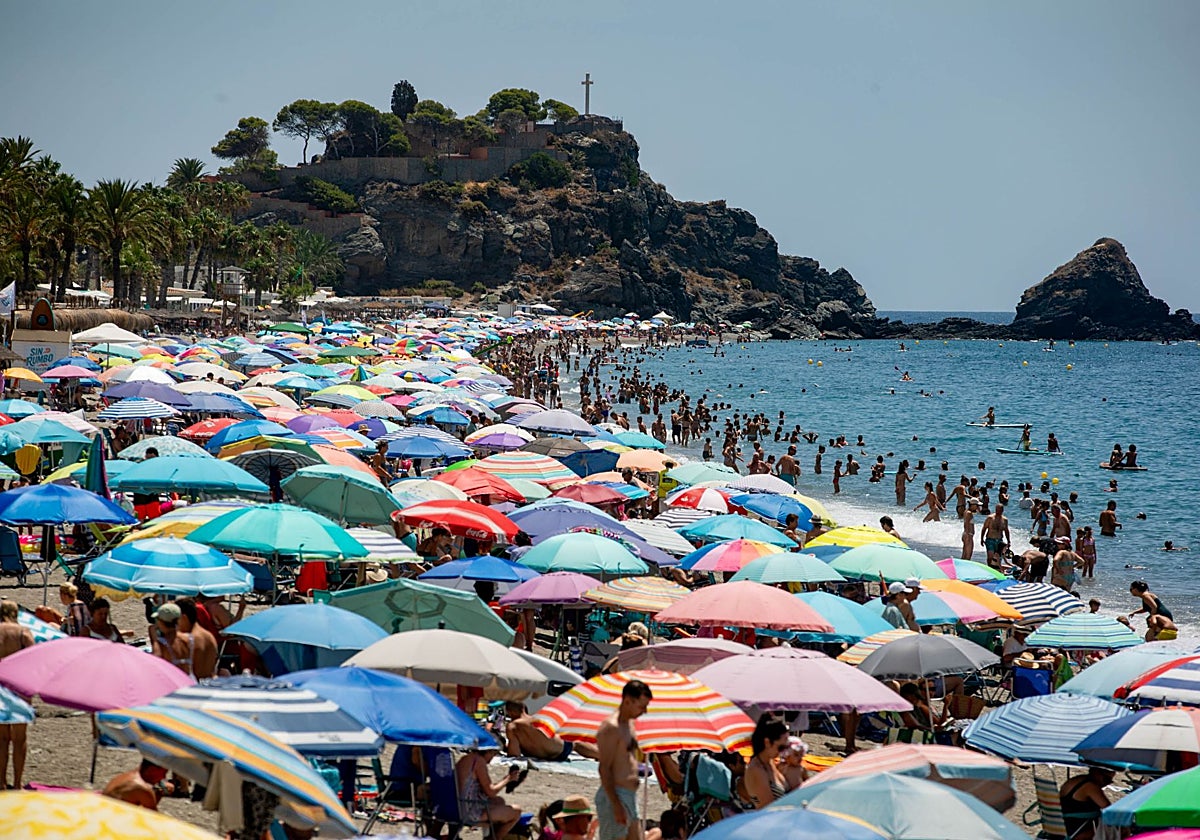
"In Almuñécar and La Herradura we have 28,000 residents, but we are currently providing services to 100,000 people," the mayor told IDEAL He went on to say, "This means that for weeks on end we have to operate as if we were a town four times our size, yet our resources are still calculated primarily on the basis of the population listed on the register."
Ruiz Joya believes that the current debate on the introduction of tourist taxes "should not obscure a much deeper issue: how public services are funded in those municipalities whose population swells for much of the year as a result of tourism".
"We have a population of 28,000, but today we are providing services to 100,000 people"
In his view, introducing a tourist tax in Andalucía could be a positive step, but it is still merely an inadequate stopgap measure to resolve a more complex problem. "The tourist tax falls short," said Ruiz Joya, who agrees with Granada city hall that the appropriate forum for this debate is the negotiating table established during the previous legislative term between the Andalusian federation of municipalities and provinces (FAMP) and the Andalusian regional government's tourism department, currently headed by Manuel Gavira of the right-wing Vox political party, who has not yet set out his position on the matter. "It makes no sense for us to go it alone: that would spell the beginning of the end for the tourist tax," he argued.
Related story

Ruiz Joya points out that the underfunding faced by Almuñécar is a problem shared by many Spanish tourist destinations, which bear a significant increase in costs relating to street cleaning, waste collection, policing, traffic, car parks, rescue and first-aid services, Civil Protection, beach maintenance, water consumption and management, sanitation, public transport, urban maintenance and citizen services.
"The tourist tax should be discussed between the regional department of tourism and the FAMP, but it is not enough"
"Everyone who comes to Almuñécar and La Herradura should find a clean, safe and well-maintained town with high-quality public services. That is our duty and we also want to keep improving on this. The problem is that the financial burden of this ultimately falls mainly on the municipal budgets and, therefore, on our residents," he said.
The mayor believes that Spain needs to adapt its local funding system to the transformation that major tourist destinations have undergone over recent decades. "The population register is necessary, but it can no longer be the sole indicator used to fund certain town halls. Today we have data on overnight stays, hotel beds, holiday apartments, second homes, water consumption, waste production and transport. All of this allows us to determine with much greater precision how many people a city is actually serving," he said.
The mayor has announced his intention to begin contacting other tourist towns in Andalucía facing similar problems, with a view to developing a common position and subsequently putting it forward to the Andalusian regional government, the FAMP, the FEMP and the Spanish government.
Among them, he mentioned Chipiona, Nerja and Torremolinos. "This is not a matter of political parties or regions. There are mayors of tourist towns governed by different political parties who are describing exactly the same problem. That is why I believe we must sit down, analyse the data and jointly put forward a serious proposal to the Spanish government," Ruiz Joya explained.
No to tourismophobia
Ruiz Joya has clarified that this initiative is not driven by any animosity towards tourists and has rejected any suggestions that it pits residents against visitors. "Tourism is part of our history, our economy and our future. It creates thousands of jobs, supports our businesses and shops, and raises the profile of Almuñécar and La Herradura both within and outside Spain. Our approach is not directed against tourism; on the contrary, it has been devised precisely to protect our model of tourism and enable us to offer better services," he said.
The mayor pointed out that "the residents of Almuñécar and La Herradura pay their taxes and through these we help to maintain services that, at certain times of the year, are used by tens of thousands more people. It is only logical that a share of the wealth generated by tourism for the country as a whole should be returned to the local authorities that make this activity possible and directly bear its costs".
The town hall plans to begin work on a financial report to quantify the actual increase in demand on the main municipal services during the tourist season and use this data as the basis for the proposal.
"Almuñécar wants to launch this debate in Spain. If tourism is one of our country's major economic drivers, the local authorities that support that tourism must also receive fair funding. Tourism, yes; visitors are always welcome; and first-class public services, but with resources that reflect the reality of our towns," he concluded.
Read comprehensive news from Granada province's Costa Tropical.
![[]](http://static.vocstatic.com/voc26/latest/assets/images/favicon/surinenglish/apple-touch-icon-57x57.png)