
History
Underwater archaeologists identify 1887 Italian shipwreck off Marbella coast
Andalusian institute of historical heritage confirms identity of Neapolitan merchant vessel Garigliano lost in storm off Cabopino with Marseille tile and cement cargo

Marbella
The archaeological mystery lying on the seabed off Cabopino, in Marbella, is now much better understood.
The latest archaeological investigation carried out by the Andalusian ... institute of historical heritage (IAPH), through its centre for underwater archaeology (CAS) and in collaboration with Granada university, has concluded with new evidence leading to the definitive identification of the shipwreck that sank in November 1887: it is the Italian brig Garigliano. This is one of the key findings to have emerged from the research, which is not yet complete and will continue in 2027 with further dives.
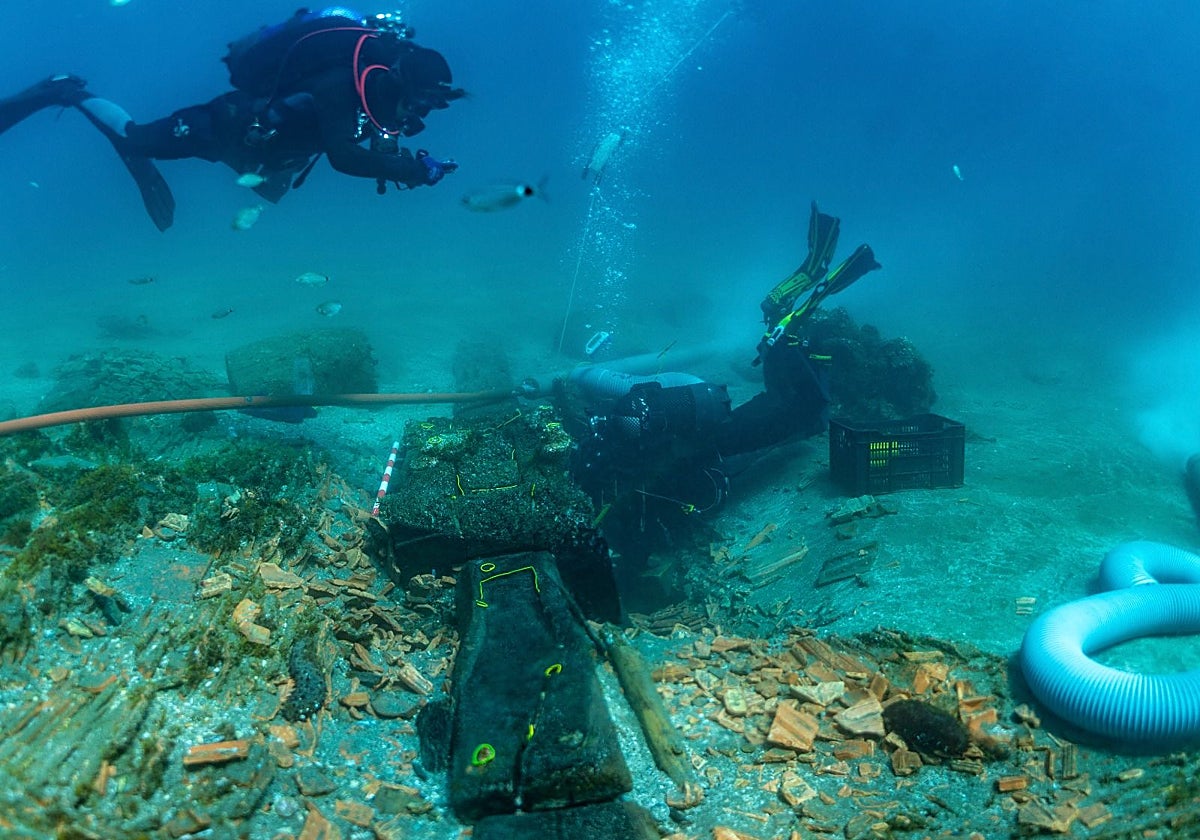
The fieldwork, carried out during the second half of September and lasting 15 days, has enabled substantial progress to be made in characterising this transoceanic merchant ship flying the Neapolitan flag, which in 1887 set sail from Marseille bound for Buenos Aires until a storm thwarted its voyage off the coast of Marbella.
Field measurements have already documented 34 metres of the ship’s structure that are visible, a figure consistent with the approximately 45-metre length that, according to historical records, vessels of this type reached in the late 19th century.
Furthermore, scientists have been able to determine the exact position in which the ship came to rest following the accident: the Garigliano ran aground with its bow pointing towards the beach and suffered a pronounced list to port. The main hypothesis being pursued by the regional ministry of culture is that both sides of the hull eventually gave way and buckled outwards due to the enormous weight of the cargo once the structure lost its stability.
Related story
-
History
José Carlos García
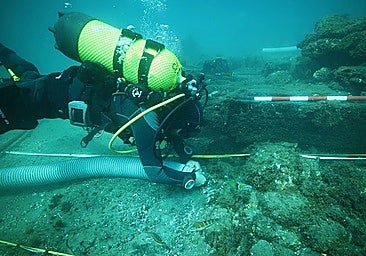
To determine the layout of the ship, two strategic test pits were excavated: one at the bow, focusing on the area around the forestay socket (the structural element into which the mast fits); and the other in the central section, next to one of the preserved bulkheads, in order to analyse the internal compartmentalisation and the layout of the cargo hold.
The entire project has been accompanied by an "extensive programme" of photographic and audiovisual documentation, including 360-degree video footage
In addition, archaeological cleaning work has been carried out on the starboard side and on a section of the cargo, revealing various stowage levels. The entire operation was accompanied by an "extensive programme" of photographic and audiovisual documentation, including 360-degree video footage that has captured the site in an immersive manner. The operation also included photogrammetric documentation aimed at generating a precise three-dimensional model of the wreck and the areas under investigation.
Barrels of Roman cement
Analysis of the cargo continues to reveal the crucial role played by this trade route, which supplied a Buenos Aires in the midst of an urban boom — whose GDP grew by 141 per cent between 1881 and 1889 — with high-quality building materials from the French Mediterranean. So far, the excavations have identified four distinct types of tiles bearing the marks of potteries in the Marseille and Aubagne area: Pierre Lançon, Roux B. Martin and A. Remuzat. In addition to these, there is a range of roof tiles identified as having been produced by Pierre Sacoman, from the Saint-Henri district of Marseille.

The find of "particular interest" from this campaign has been the discovery of 26 barrels. Archival records had already indicated that the Garigliano carried Roman cement, so the team has taken samples from the barrels - which still contain some of their original contents - to analyse their chemical composition in the laboratory, in order to confirm this. Samples have also been taken from the wood of the structure to identify the species used in the shipyard and from the protective copper cladding of the hull.
The regional minister for culture and historical heritage, Patricia del Pozo, praised the work of the CAS for "contributing new insights into our shared past through research into the historical remains found on the seabed off the Andalusian coast". The research, however, is not yet complete. The IAPH has confirmed that it plans to carry out a new diving campaign in 2027 to continue exploring the site in greater depth. Almost 140 years after that storm of 1887, the seabed off Marbella continues to bring to light the submerged history of international trade.
